John Walsh is currently running a Flux Magazine brief again for the second years, so for inspiration he showed Pina, Die Klage der Kaiserin, the first film by choreographer Pina Bausch, and I tagged along. After watching this film, I will never look at contemporary dance in the same way again. I found the film wonderfully weird and got really engrossed in the strange mirroring of 'reality' through dance. The movements seemed completely natural, not rehearsed. I became really inspired by the absolute expression of self within the film. Often seeing things on screen can dilute them but when I really thought about what the people were doing in the film I became fascinated by the ever evolving narrative. It is interesting to think that a film which seems so obscure and seemingly sub-cultural could easily be an influence for many big screen, popular films. I could see how Black Swan could have been influenced by this and certain Tarantino films. I like the thought that an idea can start as one thing and evolve into new and changing things until on a fine thread remains between beginning and end, a subtle non-obvious link. Anything can be inspirational and can be a seed of a new idea. I really want to make my own film after watching Pina, so I think I might.
Showing posts with label Motion. Show all posts
Showing posts with label Motion. Show all posts
Friday, 8 April 2011

Sam Meech Workshop
I was asked to joined the second year film workshop, which was ran by Sam Meech. I had completed a project in second year which used found film to map out the song, Heroin, the Velvet Underground. I felt like this workshop was ideal for me to return to moving image and get my hands on some archival footage courtesy of the North West Film Archive.
In the first session, Sam wanted to see how we each responded to the same set of ingrediants in different ways. therefore he oddly brought in a wide selection of fruit and veg and asked us all to make our own smoothies, this was really enjoyable (and healthy) and despite my huge aversion to beetroot, my smoothie turned out nicely.
Then it was time to apply this technique to film, Sam gave us each the same set of film clips, selected from the archive, the rest of the workshops were spent manipulating and amalgamating this footage using the skill sets Sam had given us. Each person showed their unique work in progress. I experimented with female and male gaze, here is the film, which I will most likely continue to develop
...
Monday, 11 October 2010
Animated Routine
p
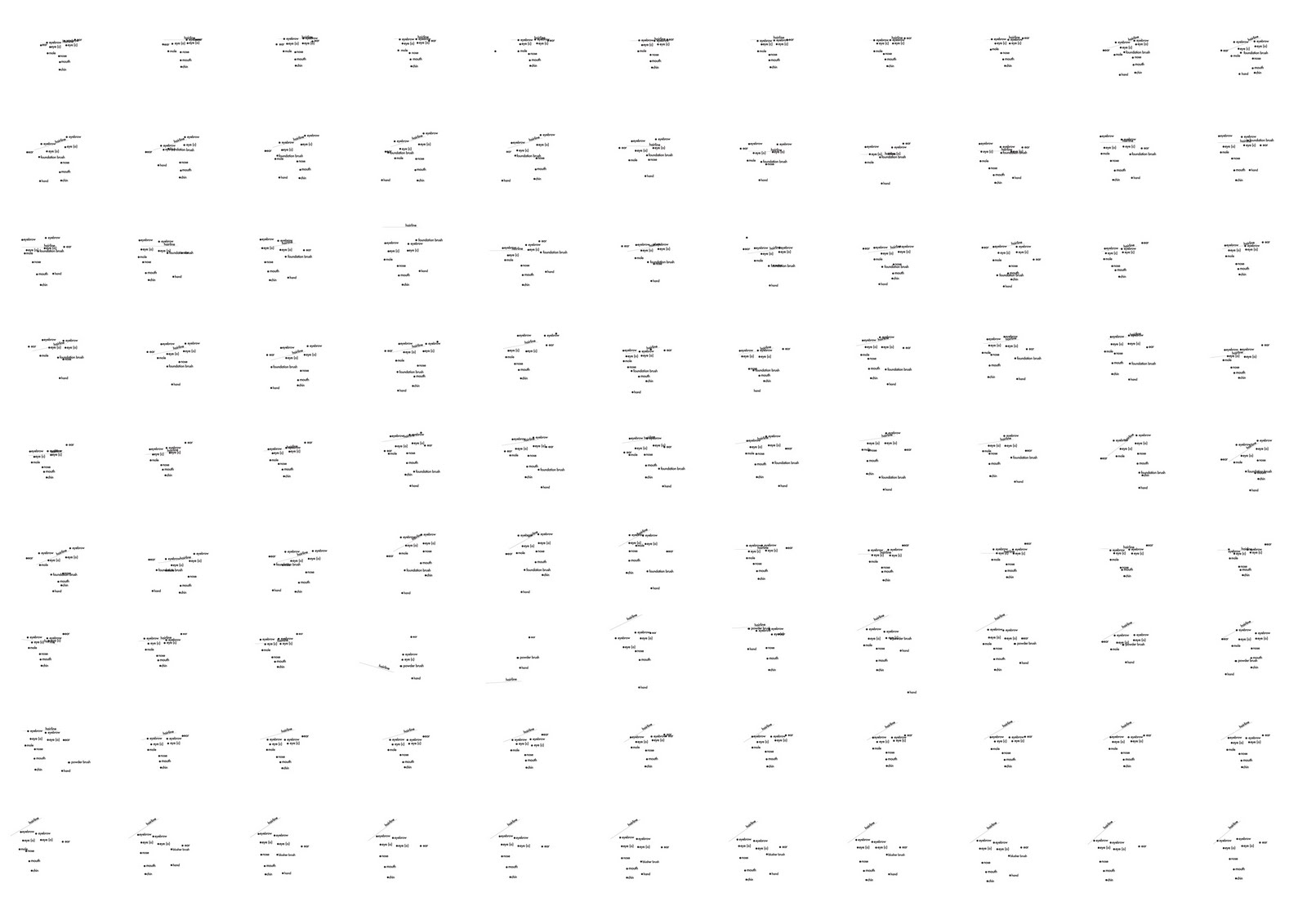
Needs more work on the timing to reflect the actual action the map is portraying, but here's my first attempt at animating the map.
Wednesday, 6 October 2010
Marxism Today
 Phil Collins: Marxism Today
Abandon Normal Devices (AND)
Cornerhouse, Manchester
02 October - 20 November
Phil Collins shines a light on what is generally perceived as the losing side in the political and social upheavals of the past two decades. The film shows contemporary interviews with ex-teachers, specialising in Marxist-Leninist ideals in the former Communist East Germany.These interviews are combined with archival material creating an interesting introduction to the topic. My interest in Germany is constantly evolving, especially Berlin and it's rich history and after spending a lot of the summer there, I felt this was an exhibition for me. I found the screening very emotional and insightful, it is one thing to learn about the history of place by reading a list of facts, but when exposed to a series of emotions and personal experiences, I felt I could really start to put my knowledge into context and understand what it was really like during that time. There were beautifully sensitive examples of archival material combined with the harsh documentary style of the interviews. A real sense of time came through with the screening. Hearing the teachers talk in retrospect about the end of communism and the possibility of becoming rich, there seemed to be split opinions referring to the pros and cons of the party. In one way there was an opportunity to become rich, but in another way some people felt that now they were doing things purely for material gain, rather than for themselves. In the next room a screening of a modern classroom brings the central concepts of Marxist economic analysis to the new generation of students, whose questions are very insightful and thought provoking. This topic is something I am very interested in and as a delve further into the social/ political impact of Photo Montage, this could be something I revisit.
Unspooling


 Unspooling
Abandon Normal Devices (AND)
Cornerhouse, Manchester
02 October - 09 January 2011
Work from 18 artists that use of abandon the usual conventions of cinema. The name of the exhibition was what first intrigued me, triggering my fascination with spools, tapes and recording. Inside a range of cinematic/artistic strategies are spread over two floors including sound, gesture, spoken word, painting, drawing and sculpture. Something must be said for the curators of the exhibition, as the spacing and positioning of the pieces around the room worked well to enhance the viewer experience. Julian Moisander's The Manager, 2010, shows a hanging man projected high up near the ceiling of the gallery, whilst Ming Wong's Life and Death in Venice, 2010, is projected onto impossibly thin perspex sheets, which appear to be floating independently in the space, beautiful. Intricate installation is seen inMichaël Borremans', The German 2004- 2007. A scale model of a cinema space, shrunk to a miniscule size, contains incredibly detailed, tiny figurines, who observe the comparitively giant screen, showing the jerky mannerisms of a suited man. Whether it is the model or the film we should focus upon is unimportant, in any sense it made me stop and look closer ,which deserves some credit.
My main point of interest within this exhibition were not the works themselves but the way the works had been presented, which I thought could be applied to my degree show/ D&AD exhibition in the future.
Saturday, 2 October 2010

Wednesday, 25 August 2010
The Surreal House

 Review:
A wall collapses here, a door upends over there. An egg-shaped abode hides a womb-like interior and there's a creeping suspicion that all is not well at home. 'The Surreal House' is an ambitious and rewarding, if necessarily sinister peek into some of the most bizarre dwellings imaginable - its scope grand enough to include art, architecture, film and photography, while its atmosphere close and cloying enough to induce moments of sheer terror and genuine delight.
Film emerges as the most powerful medium in 'The Surreal House' with Jacques Tati's hapless 'Mon Oncle' and Jean Cocteau's 'La Belle et La Bête' contrasting the ridicule of modern living with a wildly romantic fairy tale fantasy - but both require that you watch them in their entirety in a specially built cinema. The show proper opens with Buster Keaton's famous slapstick sequence from 'Steamboat Bill Jr', in which his own house is blown down around his ears, and leads you to the objects contained within the Barbican's custom-built structure. Yet neither a pair of Duchamp's darkened French windows (called 'Fresh Widow') or his cheeky rubber-foam boob in place of a doorbell, give any real clues as to what's inside. The initial shock then comes when presented with a blacked-out bathroom, where Rachel Whiteread's sepulchral resin cast of the space under the tub greets visitors with our own grubby mortality.
A spyhole refuses to reveal the secrets behind Sigmund Freud's front door, but the meister of repression's office chair is here in his stead. Alas, we soon get Freud's massively overused theory of what makes a surreal house a home for nasty memories practically shoved down our throats. His notion of the unheimlich, or unhomely, is appropriate in this context, but is little more than paying lip service to art-speak cliché - it's now shorthand for anything a bit 'strange' in contemporary art.
The earliest spaces to mimic Freud's ideas were the original and best surreal houses: André Breton's elegant apartment shelves appear on camera, filled with a curio collection of the highest order (shamefully auctioned off piecemeal in 2003) and none other than the 'Great Masturbator' himself, Salvador DalÌ, created some of the most outlandish and unreal environments, not least his 'Dream of Venus' pavilion created for the 1939 New York World's Fair. Trying to marry DalÌ's paintings with later architecture is a major mistake, however, especially in the nonsensical pairing of his 1937 'Sleep' with Rem Koolhaas's villa on stilts from 1991, chiefly because it does the overarching theme no favours at all.
Everything takes a surreal turn for the better when the curators play, not at intellectual ping-pong or tenuous connect-the-dots, but at impressive interior design. A crumpled, clanking piano by Rebecca Horn hangs from the parlour ceiling, a locked door guards an artist singing as he wipes on the toilet, a lonely window stares down on an unloved Sarah Lucas mattress in the bedroom, while Jan Svankmajer's troubling nursery of animated toys is a welcome burst of colour in an otherwise monochrome world. Not every allusion works - Maurizio Cattelan's sorely punished mannequin boy with pencils stuck through his hands is no more than a lame joke, as is Edward Kienholz's waiting room, in which the armchair resident has long ago been reduced to a dusty skeleton. Without the drama of the house motif to its layout, the upper floor suffers badly by comparison, although a trio of Joseph Cornell boxes significantly ups the dwindling masterpiece quota.
Thankfully, the numerous female artists in the exhibition are not unfairly included here as inherently domestic beings or confined by any stereotype that they're unable to control their natural homemaker's urges. In fact, the most acute representations of domicile distress by Louise Bourgeois and Francesca Woodman effectively consign their male counterparts to the basement of the genre, although the last word goes to Russian auteur Andrei Tarkovsky and to his chosen form: art house film. The end sequence to Tarkovsky's 'The Sacrifice' of 1986, in which the protagonist burns down his house, thus freeing himself from the enslavement of nostalgia that his cups, dressers and tables inflicted upon him on a daily basis, is a telling reminder of what alienating, divisive and constrictive environments we live in. 'The Surreal House' is ultimately a metaphor for our unconscious mind. It's filled with knick-knacks and memories - some important, others not - but it's when something in there snaps or goes missing that the comfort and homeliness we crave lay bare that much darker place.
Review:
A wall collapses here, a door upends over there. An egg-shaped abode hides a womb-like interior and there's a creeping suspicion that all is not well at home. 'The Surreal House' is an ambitious and rewarding, if necessarily sinister peek into some of the most bizarre dwellings imaginable - its scope grand enough to include art, architecture, film and photography, while its atmosphere close and cloying enough to induce moments of sheer terror and genuine delight.
Film emerges as the most powerful medium in 'The Surreal House' with Jacques Tati's hapless 'Mon Oncle' and Jean Cocteau's 'La Belle et La Bête' contrasting the ridicule of modern living with a wildly romantic fairy tale fantasy - but both require that you watch them in their entirety in a specially built cinema. The show proper opens with Buster Keaton's famous slapstick sequence from 'Steamboat Bill Jr', in which his own house is blown down around his ears, and leads you to the objects contained within the Barbican's custom-built structure. Yet neither a pair of Duchamp's darkened French windows (called 'Fresh Widow') or his cheeky rubber-foam boob in place of a doorbell, give any real clues as to what's inside. The initial shock then comes when presented with a blacked-out bathroom, where Rachel Whiteread's sepulchral resin cast of the space under the tub greets visitors with our own grubby mortality.
A spyhole refuses to reveal the secrets behind Sigmund Freud's front door, but the meister of repression's office chair is here in his stead. Alas, we soon get Freud's massively overused theory of what makes a surreal house a home for nasty memories practically shoved down our throats. His notion of the unheimlich, or unhomely, is appropriate in this context, but is little more than paying lip service to art-speak cliché - it's now shorthand for anything a bit 'strange' in contemporary art.
The earliest spaces to mimic Freud's ideas were the original and best surreal houses: André Breton's elegant apartment shelves appear on camera, filled with a curio collection of the highest order (shamefully auctioned off piecemeal in 2003) and none other than the 'Great Masturbator' himself, Salvador DalÌ, created some of the most outlandish and unreal environments, not least his 'Dream of Venus' pavilion created for the 1939 New York World's Fair. Trying to marry DalÌ's paintings with later architecture is a major mistake, however, especially in the nonsensical pairing of his 1937 'Sleep' with Rem Koolhaas's villa on stilts from 1991, chiefly because it does the overarching theme no favours at all.
Everything takes a surreal turn for the better when the curators play, not at intellectual ping-pong or tenuous connect-the-dots, but at impressive interior design. A crumpled, clanking piano by Rebecca Horn hangs from the parlour ceiling, a locked door guards an artist singing as he wipes on the toilet, a lonely window stares down on an unloved Sarah Lucas mattress in the bedroom, while Jan Svankmajer's troubling nursery of animated toys is a welcome burst of colour in an otherwise monochrome world. Not every allusion works - Maurizio Cattelan's sorely punished mannequin boy with pencils stuck through his hands is no more than a lame joke, as is Edward Kienholz's waiting room, in which the armchair resident has long ago been reduced to a dusty skeleton. Without the drama of the house motif to its layout, the upper floor suffers badly by comparison, although a trio of Joseph Cornell boxes significantly ups the dwindling masterpiece quota.
Thankfully, the numerous female artists in the exhibition are not unfairly included here as inherently domestic beings or confined by any stereotype that they're unable to control their natural homemaker's urges. In fact, the most acute representations of domicile distress by Louise Bourgeois and Francesca Woodman effectively consign their male counterparts to the basement of the genre, although the last word goes to Russian auteur Andrei Tarkovsky and to his chosen form: art house film. The end sequence to Tarkovsky's 'The Sacrifice' of 1986, in which the protagonist burns down his house, thus freeing himself from the enslavement of nostalgia that his cups, dressers and tables inflicted upon him on a daily basis, is a telling reminder of what alienating, divisive and constrictive environments we live in. 'The Surreal House' is ultimately a metaphor for our unconscious mind. It's filled with knick-knacks and memories - some important, others not - but it's when something in there snaps or goes missing that the comfort and homeliness we crave lay bare that much darker place.
Monday, 2 August 2010
Deutsche Kinemathek/Museum für Film und Fernsehen


Transported to the third floor by the speedy lift, I was initially introduced to the history of Television (fernsehen). I walked into a room featuring famous early TV broadcasts including the first man on the moon, Queen Elizabeth's coronation and of course Boris Becker becoming Wimbledon champion. I moved into the next room (but not before analysing whether the reason people thought My boyfriend and I were German was because of Graham's uncanny resemblance to Herr. Becker)
The next room was by far the highlight of my Television experience, essentially this room was a crash course in television history from its birth to the present day. Nine screens make up the back wall, whilst mirrors encase the left and the right, and the audience perch on seats. An impressive video montage plays but this isn't your average history lesson. The combination of small screen, two screens, half screen, full screen, mixed with contrasting audio and overlapping narratives, sound collages and impeccable timing (all heightened by the all encompassing mirror walls) lends itself to a saturated visio-audial experience, leaving the audience excited and anticipant for what is to come. Once leaving the video room, there is an opportunity for a blast from the past, as visitors can browse through television programmes new and old. (my choice was 'Pingu' - the one where Pinga is born)

After television it's down to the second floor to Film, again introduced by an impressive installation, a clever use of mirrors and a bombardment of Hollywood icons, film noir, and juxtaposition of genres, is quite overpowering and emphasises the impact of 'the big screen.'
The museum takes you through a journey from the very first film camera, pioneers in German/ world cinema including the lumiere brothers and the first stars of german cinema; Henry Porten, Fern Andra and Asta Nielsen.

I was particularly interested in the section based around 'The Weimar Republic' (1918-33). Prominent directors during this time included: Ernst Lubitsch, FW. Murnau, Fritz Lang, GW. Pabst. A plaque reads "Everyday life and myths, triviality and trashiness, technology and horror- explosive elements that take shape in the Weimar republic- glaring too are the warning signs that herald the coming dictatorship."
Film was to become an important tool of propaganda during the years leading upto and including the second world war.
In contrast, the next room pays homage to Marlene Dietrich (1901-1992), who rose to fame in both Berlin and Hollywood. Her appearance in men's clothing, deftly overstepped the limits of traditional gender roles and she is admired here as the icon of the century. As part of the homage as fascinating cabinet contains many of Marlene's belongings; a vanity case, blemish cream, porcelain white make-up and one thing in particular which caught my eye was a napkin, which Marlene had written on (in English)
"He was my master
My trainer
He had me on a leash
It was he who let the Leash go- Not I
I was lying there, staying there, waiting for another master"
This was written in relation to director Joseph Von Sternberg, whom Marlene collaborated with for many years.
After Marlene has been done justice, there museum moves onto important films throughout history, including both German and American influence. One of these films being `Metropolis' for which films posters, set sketches and plot outlines can be seen. The museum also hosts a hall of fame for influential directors throughout German history including; Werner Herzog (The Enigma of Caspar Hauser), Wolfgang Peterson (Das Boot), Fritz Lang(Metropolis) and Robert Wiene's Das Cabinet Des Dr. Caligari" with the message 'you must become Caligari'.

Fritz Lang

Poster for Metropolis.
Overall I thoroughly enjoyed the museum, and felt it gave a me a richer understanding of the importance of film, specifically in Berlin. The museum also raised my awareness of the political impact of films, and how the film industry, like many art forms, was brutally affected by Hitler's regime. The film industries ability to re-build itself is a testament to the power of film, I look forward to using this visit in my summer project about 'arthouse' films, and of course raided the museum gift shop for some beautiful black and white postcards...
"As an Art form, a film must become a living print" ("Das Filmbild Muss Graphik werden") - Robert Wiene.

Gary Cooper, 1934 by Clarence Sinclair Bull.

Marlon Brando and Mary Murphy -The Wild One

Clint Eastwood, "Play Misty for Me"
Tuesday, 22 June 2010


Tuesday, 2 March 2010


Tuesday, 16 February 2010
BBC TWO


 A History Of Idents.
Although both part of the BBC, the two channels need to have thier own subtle identity, now unified by Lambie-Nairn's logo, however these new idents (2009) give the channel an ownership.


BBC ONE
The BBC have gone through many idenitities, yet have remained a pillar of society within Britain.
It's come a long way since 1936.
BBC One.

First Ident "the Bats Wings" (1953-63) Created by Abram Games.

Designed by Lambi-Nairn, who also designed The 1997 relaunch of the corporation's logo utilising the Gill Sans font, which has remained across most channels. (lambie-Nairn also designed the 'block' logo for channel 4.


Red Bee Media
"Our brief was to try and ensure that what we emerged with at the end - within the tight constraints of idents: twelve seconds and a living hold - was something that would reward repeat viewing.
"The pitch-winning idea was a simple one and was born directly from how controller Peter Fincham talks about his vision for the channel. To celebrate BBC One's unique ability to bring people together, we highlighted magical moments when people come together as one.
"We chose the symbol of a circle for a number of reasons. Throughout history it has been an emblem of unity. It's the shape we make when gathering to listen to a story. And it's a subtle reference to BBC One's own history. Its very first idents, even before the globe, always referenced a circle in some way.
Channel 4
Every channel has it's own personality. Factors to consider:
- Logo
- Idents
- Soundtrack/Jingle
- Programme announcements
- TV guide
- Website
- Merchandise
- Billboards
- Posters
- Promotion
- Target Audience
etc...
Channel 4
Every Channel has to start somewhere. The first voiceover ever heard on Channel 4 was that of Paul Coia he said : "good afternoon.It's a pleasure to be able to say to you: Welcome to Channel 4"
The soundtrack of channel 4 was 'Fourscore' composed by Lord david Dundas, and can be found here: http://www.youtube.com/watch?v=S8-_8Pc-YGk
The first programme to air was Countdown and the first person to be seen on channel four was Richard Whiteley and second, and first woman was Carol Vorderman.

Original Channel 4 Logo (1982)


Creative Director: Brett Foraker.
"Recapture the boldness and dynamisn of the original logo from 1982, in a thoroughly 21st century way"
Reflect channel 4's uniques values, the forefront of contemporary design.
Big, Bold, Engaging.
Children of Channel 4-
E4, More4, Film4, 4Music
Tuesday, 19 January 2010
A Good Wife Guide (The Film)
Here is an animation I did to try and animate 'A Good Wife Guide' from a layout project I created in first year. I wanted to state three rules and try to portray them using moving image, I wanted to stay ture to the handmade collage nature of the original project and the authentic 'worn' look of the 19403/50s ephemera I have collected.
The animation is a little fast, and here the example is small, but hopefully it gives you an idea.
NM
Music courtesy of 'It Felt Like A Kiss' and Jay-z
It Felt Like a Kiss!WATCH ME.


Just had to post this, as the film from the fascinating collaboration between Punchdrunk, Adam Curtis and Damon Albarn has become available to watch once more on bbc I-Player. The film was shown in snippets on various screen within different settings ; i.e living rooms, c.ia offices etc, and then the whole story comes together as the audience sit in a discarded party tent to watch the pieces fit together, waiting for the dream to end and the nightmare to begin. The beautful thing about the film is that it doesn't appear to have clear start or end, the film plays loop and the audience experience it at varying start points, yet the film still makes sense.
"I think we can get down into what a woman wants to feel, which is daring and a little bit...she wants to get away with something..if she has a chance to get away with something she wants to get away with atleast."
http://www.bbc.co.uk/iplayer/episode/p003x62n/Adam_Curtis_It_Felt_Like_a_Kiss_The_Film/
Tuesday, 1 December 2009

Wednesday, 25 November 2009
Heroin; The Velvet Underground.
I'm Gona Try...
When asked to create a map based around the song 'Heroin' by The Velvet Underground, I pondered many things. I felt that a technical, mechanical or mathematical map would not be appropriate, and wondered whether a map which expressed emotion could be possible. Not a series of emotions presented in a formulaic way, but a map which actually
expresses and evokes emotion.
For this it was essential to look beyond the song, it wasn't enough to listen to the song itself (although this was important) but also to research the culture behind the song, the history, connotations, era, links, connections, feelings, lifestyles, movements, artists etc. Below is a map of what I felt were the most important connections;
 I began looking at Aspen magazine, a 3D multimedia magazine in a box. I found that issue 3 was designed and edited by Warhol and David Dalton.
There appeared peices of art from the cultural gamut ( Litchenstein, Jasper Johns, DeKooning etc) aswell as quotes, ranting, ravings and various contributions from The Velvet Underground themselves....this became a priceless resource during the project and helped me gain a deeper understanding of the band. Credit where credits due, this website has managed to salvage the components from each issue and amazingly preserved them on this website.
http://www.ubu.com/aspen/intro.html
During the project I was amidst a moving image workshop, therefore a natural progression within my research was to look a Andy Warhol films... (torture a cliche), but I felt his presence and influence on the Velvet Underground could not be ignored. I found myself not looking at Warhol in the conventional 'mainstream' pop artist he is so often perceived as, but as an individual of his time, who had much influence on many people, and above all was authentic, which I admired.
Some of the films I looked at;
Beauty Number 2
http://www.youtube.com/watch?v=sF5O7YXUJfU
Andy Warhol Eats Hamburger.
http://www.youtube.com/watch?v=jaf6zF-FJBk
Through Aspen, I also began looking at Dada cinema, in particular Hans Richter, as he had appeared within a later edition of the magazine, when a film reel of 'Rhythm 21' was included within the box...
http://www.youtube.com/watch?v=QEgULqLn5iU
To summarise, I knew I somehow wanted to use the idea of 'bad cinema'; distortion, purposely out of focus, maybe black and white film, but ultimately experiment with processes to see if any suitable outcome came through, initially I wasn't concerned with fitting the work to the song, that would come later.
A Two fork road.
Like I said 'process' was my first point of call, so I began simply with a sketchbook page, which displayed the song lyrics and proceeded something like this;
Process-photocopy-enlarge-repeat-photocopy-enlarge-repeat until page is all black or all white- photograph-contact sheet- shred- tape together shreds- put through reel to reel tape player- photograph-print-photocopy-enlarge-repeat- wet in bath- dry- make collages.....create animation; (video displayed at foot of page)
Second Road; after various tutorials, I decided the idea of processes alone, was not ambitious enough, so as well as carrying on with that I decided to take a completely new approach to the idea of mapping. I decided that after listening to the song, that the words I , I'm, I'll are mentioned at moments of particular intensity, I decided to highlight these words in each verse. I then counted the words between each I, I'm, I'll etc, and noted this down.
I have always loved the idea of found images, and for this project I thought it would be interesting to perhaps experiement with 'found' video/film. This brought me to a charity shop back home, which was rich with a vast video collection, at a budget price... and lucky for me it was 3 for 2.
I decided that the number of words between each I, I'll or I'm, should correlate to the positioning of the videos on the shelf. (i.e) 'I...3 words later ...I'll' would mean 'First video...three videos later pick another video) This would give me some structure, but also a completely unexpected outcome, as I could never predict which videos would be where. Here is the original shelf format, red dots represent videos I chose. Below is also the final videos with numbers which represent words between I, I'll or I'm.
I began looking at Aspen magazine, a 3D multimedia magazine in a box. I found that issue 3 was designed and edited by Warhol and David Dalton.
There appeared peices of art from the cultural gamut ( Litchenstein, Jasper Johns, DeKooning etc) aswell as quotes, ranting, ravings and various contributions from The Velvet Underground themselves....this became a priceless resource during the project and helped me gain a deeper understanding of the band. Credit where credits due, this website has managed to salvage the components from each issue and amazingly preserved them on this website.
http://www.ubu.com/aspen/intro.html
During the project I was amidst a moving image workshop, therefore a natural progression within my research was to look a Andy Warhol films... (torture a cliche), but I felt his presence and influence on the Velvet Underground could not be ignored. I found myself not looking at Warhol in the conventional 'mainstream' pop artist he is so often perceived as, but as an individual of his time, who had much influence on many people, and above all was authentic, which I admired.
Some of the films I looked at;
Beauty Number 2
http://www.youtube.com/watch?v=sF5O7YXUJfU
Andy Warhol Eats Hamburger.
http://www.youtube.com/watch?v=jaf6zF-FJBk
Through Aspen, I also began looking at Dada cinema, in particular Hans Richter, as he had appeared within a later edition of the magazine, when a film reel of 'Rhythm 21' was included within the box...
http://www.youtube.com/watch?v=QEgULqLn5iU
To summarise, I knew I somehow wanted to use the idea of 'bad cinema'; distortion, purposely out of focus, maybe black and white film, but ultimately experiment with processes to see if any suitable outcome came through, initially I wasn't concerned with fitting the work to the song, that would come later.
A Two fork road.
Like I said 'process' was my first point of call, so I began simply with a sketchbook page, which displayed the song lyrics and proceeded something like this;
Process-photocopy-enlarge-repeat-photocopy-enlarge-repeat until page is all black or all white- photograph-contact sheet- shred- tape together shreds- put through reel to reel tape player- photograph-print-photocopy-enlarge-repeat- wet in bath- dry- make collages.....create animation; (video displayed at foot of page)
Second Road; after various tutorials, I decided the idea of processes alone, was not ambitious enough, so as well as carrying on with that I decided to take a completely new approach to the idea of mapping. I decided that after listening to the song, that the words I , I'm, I'll are mentioned at moments of particular intensity, I decided to highlight these words in each verse. I then counted the words between each I, I'm, I'll etc, and noted this down.
I have always loved the idea of found images, and for this project I thought it would be interesting to perhaps experiement with 'found' video/film. This brought me to a charity shop back home, which was rich with a vast video collection, at a budget price... and lucky for me it was 3 for 2.
I decided that the number of words between each I, I'll or I'm, should correlate to the positioning of the videos on the shelf. (i.e) 'I...3 words later ...I'll' would mean 'First video...three videos later pick another video) This would give me some structure, but also a completely unexpected outcome, as I could never predict which videos would be where. Here is the original shelf format, red dots represent videos I chose. Below is also the final videos with numbers which represent words between I, I'll or I'm.
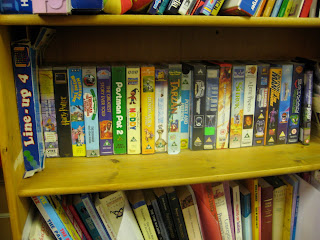

 Once I had all the videos, I counted the seconds between each I, I'm or I'll and this determined the length of each clip. The results were interesting as once second there would be Postman Pat and the next a war film. The whole video was the length of the song, plus a few more seconds, due to the interval between each verse, in total around 8 mins.
 I began looking at Aspen magazine, a 3D multimedia magazine in a box. I found that issue 3 was designed and edited by Warhol and David Dalton.
There appeared peices of art from the cultural gamut ( Litchenstein, Jasper Johns, DeKooning etc) aswell as quotes, ranting, ravings and various contributions from The Velvet Underground themselves....this became a priceless resource during the project and helped me gain a deeper understanding of the band. Credit where credits due, this website has managed to salvage the components from each issue and amazingly preserved them on this website.
http://www.ubu.com/aspen/intro.html
During the project I was amidst a moving image workshop, therefore a natural progression within my research was to look a Andy Warhol films... (torture a cliche), but I felt his presence and influence on the Velvet Underground could not be ignored. I found myself not looking at Warhol in the conventional 'mainstream' pop artist he is so often perceived as, but as an individual of his time, who had much influence on many people, and above all was authentic, which I admired.
Some of the films I looked at;
Beauty Number 2
http://www.youtube.com/watch?v=sF5O7YXUJfU
Andy Warhol Eats Hamburger.
http://www.youtube.com/watch?v=jaf6zF-FJBk
Through Aspen, I also began looking at Dada cinema, in particular Hans Richter, as he had appeared within a later edition of the magazine, when a film reel of 'Rhythm 21' was included within the box...
http://www.youtube.com/watch?v=QEgULqLn5iU
To summarise, I knew I somehow wanted to use the idea of 'bad cinema'; distortion, purposely out of focus, maybe black and white film, but ultimately experiment with processes to see if any suitable outcome came through, initially I wasn't concerned with fitting the work to the song, that would come later.
A Two fork road.
Like I said 'process' was my first point of call, so I began simply with a sketchbook page, which displayed the song lyrics and proceeded something like this;
Process-photocopy-enlarge-repeat-photocopy-enlarge-repeat until page is all black or all white- photograph-contact sheet- shred- tape together shreds- put through reel to reel tape player- photograph-print-photocopy-enlarge-repeat- wet in bath- dry- make collages.....create animation; (video displayed at foot of page)
Second Road; after various tutorials, I decided the idea of processes alone, was not ambitious enough, so as well as carrying on with that I decided to take a completely new approach to the idea of mapping. I decided that after listening to the song, that the words I , I'm, I'll are mentioned at moments of particular intensity, I decided to highlight these words in each verse. I then counted the words between each I, I'm, I'll etc, and noted this down.
I have always loved the idea of found images, and for this project I thought it would be interesting to perhaps experiement with 'found' video/film. This brought me to a charity shop back home, which was rich with a vast video collection, at a budget price... and lucky for me it was 3 for 2.
I decided that the number of words between each I, I'll or I'm, should correlate to the positioning of the videos on the shelf. (i.e) 'I...3 words later ...I'll' would mean 'First video...three videos later pick another video) This would give me some structure, but also a completely unexpected outcome, as I could never predict which videos would be where. Here is the original shelf format, red dots represent videos I chose. Below is also the final videos with numbers which represent words between I, I'll or I'm.
I began looking at Aspen magazine, a 3D multimedia magazine in a box. I found that issue 3 was designed and edited by Warhol and David Dalton.
There appeared peices of art from the cultural gamut ( Litchenstein, Jasper Johns, DeKooning etc) aswell as quotes, ranting, ravings and various contributions from The Velvet Underground themselves....this became a priceless resource during the project and helped me gain a deeper understanding of the band. Credit where credits due, this website has managed to salvage the components from each issue and amazingly preserved them on this website.
http://www.ubu.com/aspen/intro.html
During the project I was amidst a moving image workshop, therefore a natural progression within my research was to look a Andy Warhol films... (torture a cliche), but I felt his presence and influence on the Velvet Underground could not be ignored. I found myself not looking at Warhol in the conventional 'mainstream' pop artist he is so often perceived as, but as an individual of his time, who had much influence on many people, and above all was authentic, which I admired.
Some of the films I looked at;
Beauty Number 2
http://www.youtube.com/watch?v=sF5O7YXUJfU
Andy Warhol Eats Hamburger.
http://www.youtube.com/watch?v=jaf6zF-FJBk
Through Aspen, I also began looking at Dada cinema, in particular Hans Richter, as he had appeared within a later edition of the magazine, when a film reel of 'Rhythm 21' was included within the box...
http://www.youtube.com/watch?v=QEgULqLn5iU
To summarise, I knew I somehow wanted to use the idea of 'bad cinema'; distortion, purposely out of focus, maybe black and white film, but ultimately experiment with processes to see if any suitable outcome came through, initially I wasn't concerned with fitting the work to the song, that would come later.
A Two fork road.
Like I said 'process' was my first point of call, so I began simply with a sketchbook page, which displayed the song lyrics and proceeded something like this;
Process-photocopy-enlarge-repeat-photocopy-enlarge-repeat until page is all black or all white- photograph-contact sheet- shred- tape together shreds- put through reel to reel tape player- photograph-print-photocopy-enlarge-repeat- wet in bath- dry- make collages.....create animation; (video displayed at foot of page)
Second Road; after various tutorials, I decided the idea of processes alone, was not ambitious enough, so as well as carrying on with that I decided to take a completely new approach to the idea of mapping. I decided that after listening to the song, that the words I , I'm, I'll are mentioned at moments of particular intensity, I decided to highlight these words in each verse. I then counted the words between each I, I'm, I'll etc, and noted this down.
I have always loved the idea of found images, and for this project I thought it would be interesting to perhaps experiement with 'found' video/film. This brought me to a charity shop back home, which was rich with a vast video collection, at a budget price... and lucky for me it was 3 for 2.
I decided that the number of words between each I, I'll or I'm, should correlate to the positioning of the videos on the shelf. (i.e) 'I...3 words later ...I'll' would mean 'First video...three videos later pick another video) This would give me some structure, but also a completely unexpected outcome, as I could never predict which videos would be where. Here is the original shelf format, red dots represent videos I chose. Below is also the final videos with numbers which represent words between I, I'll or I'm.


 Once I had all the videos, I counted the seconds between each I, I'm or I'll and this determined the length of each clip. The results were interesting as once second there would be Postman Pat and the next a war film. The whole video was the length of the song, plus a few more seconds, due to the interval between each verse, in total around 8 mins.
So I had at my disposal two very different sets of film. The next logical step seemed to be to try and combine the video map , with my 'processes' animation and see which outcome prevailed. When I watched both the animation and the 'Video Map,' I found there were certain sections and small details of each which I felt were more effective than others. I wanted to combine the small successful sections, happy accidents, unexpected outcomes etc, to make something more deliberate. So, having the starting point and aesthetic of the animation, and the 'Video Map' I began an editing process.
Neither the stop motion or the 'Video Map' contained the song, this was a deliberate decision, but at this stage of the project I felt that the presence of the song was now neccessary to tie the whole thing together. I chose to focus on the first verse alone, as this was long enough to fairly represent the aesthetic of both outcomes, but not so long that my audience were falling asleep.
Final Cut
To refer back to the start of this post, and my question 'Can a map be emotional?' I feel that somewhere along this journey, sometimes unintentionally but often through deliberate choices I have managed to create a 'map' (of sorts) which expresses emotion. When listening to the song 'Heroin' I felt that it portrayed the drug and it's effects, as a dependance, but also with fondness, almost like a love affair. I never wanted to express the negative connotations of the drug, but rather to try and express the meaning of the song, and try to express it in a positive way, not to endorse it (far from it), but to represent the mind set of the band and people around the band and the culture of the time. The piece shows some some beautifully sensitive scenes (courtesy of Disney) juxstaposed with scenes of conflict, battle, journeys, confusion and sometimes just absurdity; portraying a kind of love/hate relationship on wheels, which reacts to the song.
By no means do I claim to have set out to portray these ideas from the offset, but ultimately that is what I think of now when I retrospectively reflect on the project.
Although I have encountered difficulties, and traumatic problems throughout this project, I am glad that I chose moving image, as it has opened up a few more doors for me, and has allowed me to step out of my comfort zone and take risks.(final video at foot of page)
NM.
Credit:
Footage used throughout the whole project (Some elements may not have made the final cut)
Disclaimer: Clips, which have been taken from Videos are not my own work, I do not claim credit for them and a list of videos I have used is displayed below.
(In order of appearance)
The Story Keepers A.D 64: Sink or Swim/ Roar In The Night. ©1996
The greatest Story Ever Told. ©1965
Nursery Rhyme Time; 60 Favourite Children's Nursery Rhymes. ©1995
Noddy and the Naughty Tail. ©1992
We're Back; A Dinosaur's Story. ©1993
Thomas The Tank Engine & Friends. ©1991
Ice Age © 2002.
Postman Pat 2 ©1986
Showdown in Little Tokyo ©1991
Dirty Rotten Scoundrels © 1988
The Green Berets © 1968
Babylon 5 Volume 31 ©1996
Mighty Morphin Power Rangers; Classic Ranger edition © BVS International
Inspector Morse; Episode 2; The Silent World of Nicholas Quinn © 2003
Cyborg and Blood Sport starring Jean Claude Van Damme © 1987
Tarzan © Disney and Burroughs.
Harry Potter and The Sorcerer's Stone © unknown
Shrek © 2001
Edward Scissorhands © 1990.
-------------------------------------------------
(Andy Warhol Eats Hamburger)
Beauty No. 2- Andy Warhol
Hans Richter- Rhythm 21
Andy Warhol Documentary.
Tuesday, 17 November 2009

Saturday, 14 November 2009
Nice Animation from Digital Kitchen.
http://www.d-kitchen.com/blog/challenge-your-world-natural-re-sasters
took a look back at the year 2067, when man learned how to re-channel energy from natural disasters plaguing the earth.
took a look back at the year 2067, when man learned how to re-channel energy from natural disasters plaguing the earth.
Subscribe to:
Posts (Atom)

 Posts
Posts

