Pages

Showing posts with label Photo Montage. Show all posts

Wednesday, 14 December 2011

The Mad Square


Modernity in German Art 1910 – 37
National Gallery of Victoria

“Experimental, provocative and utterly compelling...”

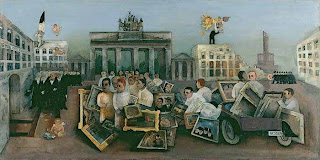
Two of my earliest memories of graphic inspirations were László Moholy-Nagy and El Lissitzky and since then Constructivism and later Modernity have been of huge inspiration throughout my career. On discovering NGV latest exhibition entitled “The Mad Square” (Der Tolle Platz), it was a pre-requisite for me to attend. The exhibition name derives from Felix Nussbaum's 1932 painting of Berlin's famous Pariser Platz. 'Tolle' translates to mean both 'mad' and 'fantastic.' which is certainly a common thread, running through the exhibition. The 'square' is approached as a physical space, with representations of the city, as well as a state of turbulence and unrest, which characterises the era.


Felix Nussbaum, Der Tolle Platz, 1932

Aptly the exhibition begins with a screen excerpt of “Das Cabinet Der Dr. Caligari,” which is the story of deadly sonambulist, Cesare, approaching mental illness in a way which forces the viewer to be sucked in and an example of early German Expressionist cinema.


My recently completed university dissertation follows themes of unrest in Weimar Germany, in relation to artists such as Hannah Höch and Marianne Brandt, both of whom feature in the exhibition. A time of turmoil within Germany inspired incredible 'avant-garde' art movements; Expressionism, Dada, Constructivism, Bauhaus and New Objectivity. It was really inspiring to me to see so many points of cultural and contextual reference grouped together in one exhibition, and especially considering their relevance and importance to my own creative development. For me the exhibition combined both artistic, graphic, physical and filmic examples of a whole spectrum of inspiration and as I followed the prominent jagged red arrow around the space I was never disappointed by what was around the next corner.


El Lissitzky, Beat the Whites with the Red Wedge, 1919


László Moholy-Nagy


Aritists featured in the exhibition include: Max Beckmann, Otto Dix, George Grosz, Christian Schad, Hannha Hoch, August Sander, Laslo Moholy Nagy, El Lissitsky
Website


Friday, 4 November 2011

Femina Moderna

I was looking into the way that pornography is often male orientated. The focus is 'man as subject,' 'women as object,' drawing similarities to male surrealist photography and Hollywood cinema. I explored their idea of the male gaze, and the feminine object, their adornment of women (why the hell not!). In relation to Surrealism, later revelations of Claude Cahun's photography (amongst others), reveal that the female surrealists had their take on subject/object also in that she became both subject and object and both male and female. So here is my take.


Saturday, 30 July 2011

Surrealism: The Poetry Of Dreams, Brisbane

SURREALISM AND CONTEMPORARY ART
23 JULY 2011
DR. MIRANDA WALLACE. (Curational manager of international art and exhibitions research)


I decided to visit Brisbane's recent major Surrealist exhibition at the Gallery of Modern Art. I was lucky enough to also catch a lecture with Dr. Miranda Wallace, the curatorial manager of the exhibition, in discussion about the relationship between the Surrealist movement and contemporary art, which enhanced my visit to the exhibition.

When asked what she liked most about Surrealism, Wallace said she finds it first of all difficult to pin down what Surrealism is, but that largely her favourite aspect is the photography and the clear influence of cinema on many surrealist photographers, including contemporary artists. It is clear that Wallace wanted emphasise this link within the exhibition as film projections consistently appear alongside static works within the exhibition. There is also a surrealist cinema season devoted to moving image, (The Savage Eye; Surrealism and Cinema) which is running alongside the exhibit.

Wallace continues that one reason why it is so hard to define Surrealism is that many works are not linked by a visual style or approach but rather it is more a 'mode of enquiry.' Surrealism sets out to approach the more challenging aspects of life; the subconscious, The invisible realm and other 'hard to access' places, in fact Surrealists were obsessed by these themes. When we consider this, it makes sense and that there isn't one all encompassing style, as if there were, there would be some suggestion that each individual's subconscious is not unique. This is not to say that there are not common themes between artists and links between certain symbolic aspects of work as well and artistic approaches, however each outcome is essentially personal to artist.

In regards to contemporary art or in fact contemporary culture, Wallace explored the fact that Surrealism has also been one of the largest influences in commercial advertising; this bringing together of random things, is a technique, which at one stage became hugely useful within advertising.  


Wallace then began to talk us through a collection of slides' some from the exhibition and some contemporary examples.

SLIDES

Victor Bauner 1934 – artificial man,

This first slide displayed a hybrid creature, displaying this idea of part human part machine. Surrealists were consistently concerned with the line between the real and unreal to perhaps create a stronger more capable human being, forever trying to cross this boundary. In the example shown, the real and the unreal are merged. An idea, which became possible after WWI when the production of prosthetic limbs rose and these hybrids appeared, bringing us closer to this surrealist vision of the unreal becoming real. Wallace made the link to The Tales of Hoffman; where a man falls in love with a mannequin; falling in love with something unreal is perhaps the ultimate bringing together of real/unreal.

Wallace touched on a lot of important things and appeared to have absolutely vast knowledge, especially in terms of Surrealism's relevance to contemporary art, theatre, literature, culture, history etc. This fascination with the body perhaps stemmed from Breton and Ernst's medical background, both trained to be doctors, until they resigned to become poets, yet their fascination with the body continued as they searched to link artificial worlds.

Ron Mueck, mask 11, 2011

contemporary example of the real and the unreal joined together
-the fantastic world


Perhaps the difference between then and now is that contemporary surrealists there is an element of humour and a replication of the movements attitudes, whereas surrealists of the time were completing a genuine search for truth, a genuine way to tap into the subconscious and make the unreal, real.

Wallace showed a slide of Bretons 1960s studio/home, which was fascinating and of which a video appears in the exhibitions, the studio is permanently displayed at the Centre Pompidou, Paris. Within the studio many esoteric objects appear. Breton had a strong belief in the power, status and mythology of objects, hence his vast an eclectic collection.

Often the question is asked 'When does the object become art? Is it when the artist pronounces it art, as if the artist somehow has a divine power. In the case of Surrealism the answer is no, an object must hold some magical power, or retain a sense of meaning or worth, never be a commodity or mass produced consumer item, perhaps found or manipulated in some way. The fall in popularity of Surrealism is largely to do with the rise of Pop Art, which was doing precisely this taking and everyday consumer object and displaying an oversized, over spruced, shiny version of it and calling it art, essentially going against everything that Surrealism was about. Refusing to commit to convention.

The exhibition itself was curated in chronological order, mapping the rise and 'fall' of Surrelaism.

Transform the world' said Marx, 'Change Life' said Rimbaud. These two orders are for us one and the same” - Bréton 1955


"Every product of disgust is capable of becoming a negation of the family is Dada: a protest with the fists of its whole being engaged in destructive action dada: the knowledge of all the means rejected up until now by the stonefaced sex of comfortable compromise and good manners, dada: absolution of logic: which is the dance of those impotent to create: dada of every social hierarchy and equation set up for the sake of values by our valets Dada absolution of memory: dada – abolition of archaology” Dad absolution of prophets Dada: absolution of the future absolute and unquestionable faith in every God that is faith in the immediate product of spontaneity."

Tristan Tszara -Dada Manifesto, 1918.

The fall of popularity in Surrealism due to the rise of Pop Art, which essentially went against everything that Surrealist was about, often the question is asked ' when does the object become art? Is it when the artist pronounces it art, as if the artist somehow has a divine power. In the Case of Surrealism the answer is no, an object must hold some magical power, or retain a sense of meaning or worth, never be a commodity or mass produced consumer item, perhaps found, but then manipulated in some way. Pop Art was doing precisely this taking and everyday consumer object and displaying an oversized over spruced shiny version of it and calling it art. 

On visiting the exhibition itself after the talk I found some very different works to what I have seen before – the surreal house was more specific, obviously centred around the house and themes of domesticity, of course this is a revisited theme from many surrealist, this show has a broader, general overview of surrealism, with a strong link to cinema in conjunction with the surreal film festival being held at the gallery, there is a clearer narrative, however when listening to the talk it seemed that Dr. Wallace's interviewer was perhaps speaking with little knowledge of Surrealism, which is perhaps effective as it is such a vast and complex subject that many of the audience may only have touched on parts of it. It was reassuring, however, that Wallace clearly had more to offer on the topic.


 Belle Du Jour, 1967

 Commercial Surrealist Film
 Early Hans Richter

Mannequin Love


Tuesday, 22 March 2011

Mad To Live

Here is a coverless mock up of the publication I have been creating, based around The Beat Generation. The book contains extracts from Allen Ginsberg's Poem, Howl, William. S. Burroughs novel, Naked Lunch and Jack Kerouac's novel, On The Road. I wanted to create imagery, which provoked my interpretation of the mood and attitude around the Beats, without being obvious or cliched. This may stay as a 9" x 6" landscape book, perfect bound, but i am also going to explore larger formats, edited formats alterntive directions for the material...(to be continued)

Monday, 21 March 2011

Idle Progression

I have been collaborating over the past few weeks with Alice Smith and The Idler Magazine. We have been illustrating an essay by Sarah Boak called 'Idling for Women,' The essay addresses a lot of themes in regards to society's attitudes towards women. Some themes include: health, beauty, fashion, advertising, mass media, social expectations, politics, the essay offers women an idle alternative to the continuous stretching and pulling of feminine identity. More about this to come soon...
courtesy of Captain Geoffrey Spaulding

Saturday, 5 March 2011

Jesse Lenz

Jesse Lenz Is 'A 22 year old artist' and has an absolutely fantastic portfolio, with a huge range of clients and is the same age as me! Here are some examples of work.

Wednesday, 2 March 2011

DR. ME Talk

After rumours of a Skype lecture, I was unsure what to expect from DR.ME and was surprised on entering the lecture theatre to find the Manchester duo present. Instead of talking over points in voices, which they self-confess, would send us to sleep, the usual rambling on about the self, certain points taking far too long, and missing out vital pieces of information. DR.ME, which is the collaborative creative name of Mark Edwards and Ryan Doyle, decided to shake things up a bit and use an automated voice to concisely explain their university and post-university journey.
I found the lecture insightful and certainly have never been to a lecture which uses this platform and true to form it did keep me engaged. I took from the lecture the idea that if you keep working, keep doing work you believe in, continue to network and most importantly enjoy yourself then opportunities will slowly but surely start coming your way. DR. ME have recently moved into their own studio, which is an incredible achievement considering they only left university 7 months ago.
After the lecture I spoke to Mark and Ryan and talked through my portfolio, I found what they had to say really helpful, their constructive criticism was good to hear as it is always good to get an outside opinion on your work. I also found it useful to discuss how they coped working abroad, as this is one of my aspirations after leaving university, so thanks guys for putting my mind at ease!
Link to my blog post on DR.ME does Urban Outfitters

Tuesday, 15 February 2011

Sir Eduardo Paolozzi; General Dynamic F.U.N

Sir Eduardo Paolozzi
General Dynamic F.U.N
Holden Gallery, Manchester.
A New Exhibition at The Holden Gallery, Manchester features 50 photolithographs and screenprints from renowned artist and sculptor, Eduardo Paolozzi. Paolozzi places disparate images next to each other and finds a connection between the two, however tenuous this may be, the treatment and composition of his prints are striking and a social comment on the world of benevolent technology.
"Thermo-nuclear weapons systems and soft drinks commercials co-exist in an overlit realm ruled by advertising and pseudo-events, science and pornography"
I found the prints intriguing and incredibly contemporary, it is clear to see that Paolozzi (b. 1924) has been a great influence to other artist working on the topic of mass media advertising and consumerism or dealing with the diversity of the image. I find that some of the attitudes expressed in his prints are reflective of those discussed in the documentaries of Adam Curtis, a sinister undertone juxtaposed with a certain 'squeaky clean-ness' are present within Paolozzi's prints and Curtis' documentaries.
After the recently attending a lecture by Vaughan Oliver, I find the exhibition especially relevant, regarding Oliver's discussion of the importance and impact of placing two seemingly disparate images together within a graphic design context. The unexpected connection can create a sense of joy, fear, horror, beauty....or a combination of jarring emotions.
I definitely recommend this exhibition to anyone interested in the semiotics of the image and the potential subversion of that.

Friday, 11 February 2011

Grafik Feature

A while back, I was set the brief to Re-Brand 'God' by TDR, Creative Director, Ian Anderson. Myself and a group of designers from my course were asked to communicate our concept for a poster design, which had the possibility of being featured in the re-launch of Grafik Magazine. Grafik magazine re-launched on 10th February and I was absolutely ecstatic to find out that my poster had been featured along with Sophie Pickup, Danny Grogan, John McPartland, Rebecca Dudgon.

Friday, 4 February 2011

Gadget

Just found this whilst looking for stock imagery in a mini replica household magazine, apparently its and electronic trouser press.

Wednesday, 26 January 2011

Faux-tograph

Shadow Catchers
Camera-less Photography
V&A Museum, London.
13th October 2010-20th February 2011
Recently I have become interested in photograms, a type of camera-less photography, which involves placing an object in contact with a light sensitive surface and exposing both to light, the area which the object blocks the light is traced and recorded on the paper.
Considering my recent interest I thought it would be interesting to see the Shadow-Catchers exhibition at the V&A, and interesting it was. I found that there were other types of camera-less photography including; a Luminograms, Chemigrams, Digital C-prints or a Dye Destruction print.
"Images made with a camera imply a documentary role, In contrast, camera- less photographs show what has never really existed. Encountered as fragments, traces, signs memories or dreams - these images leave room for the imagination, transferring the world of objects into a world of visions"
I was particularly interested in Floris Neusüss' work, the sheer scale of the photograms was impressive. He created a sense of movement in a static image, a particular favourite was the image of someone leaning back on a chair named 'Be right back' I really got a sense of the moment the photogram happened.
Neusüss also created an intriguing image, instead of using artificial light from the darkroom he exposed light sensitive paper to a thunder storm and the results came from lightening exposing the paper.
Floris Neusüss
Gary Fabian Miller's work had an extremely sensitive approach and was one of the few works which embraced colour in the show. One piece called Delphinium, showed the process of a single petal being placed directly into the negative tray and exposed onto photographic paper, incredibly delicate.
Other highlights were Adam fuss' smoke diagrams, Susan Derges, Chladni inspired responses to sound and the video documentary, which gave an insight into the lives of the artists and their thoughts on such a 'dark' process.
Susan Derges
"If you don't create. You die. It's just about survival really"
- Adam Fuss

Saturday, 8 January 2011

I Never Called You Darling

Female Erotic Fragments
I have been exploring erotic fiction and feminist writings as part of my university course. I have been writing my own story-poems from written fragments by Anaïs Nin, Sylvia Plath, Angela Carter, Pauline Réage (Anne Desclos) etc. As I was using fragments of text I felt it appropriate to use fragments of imagery to illustrate this text. I created a series of Montages, which I then collected within a small book along with the story-poems.
I also made some limited edition cards and envelopes to accompany the book or to stand alone.

Thursday, 6 January 2011

The Dusty Bullet Issue, Sue Platt

I got given this mini-zine, whichwas created by my tutoe, Sue Platt. It definitely deserves to be blogged as there are some lovely sensitive, witty and well thought out aspects, which should be celebrated. My dissertation focuses upon photo-montage, therefore it is not only useful to look at Sue for my research, but also for my personal projects.